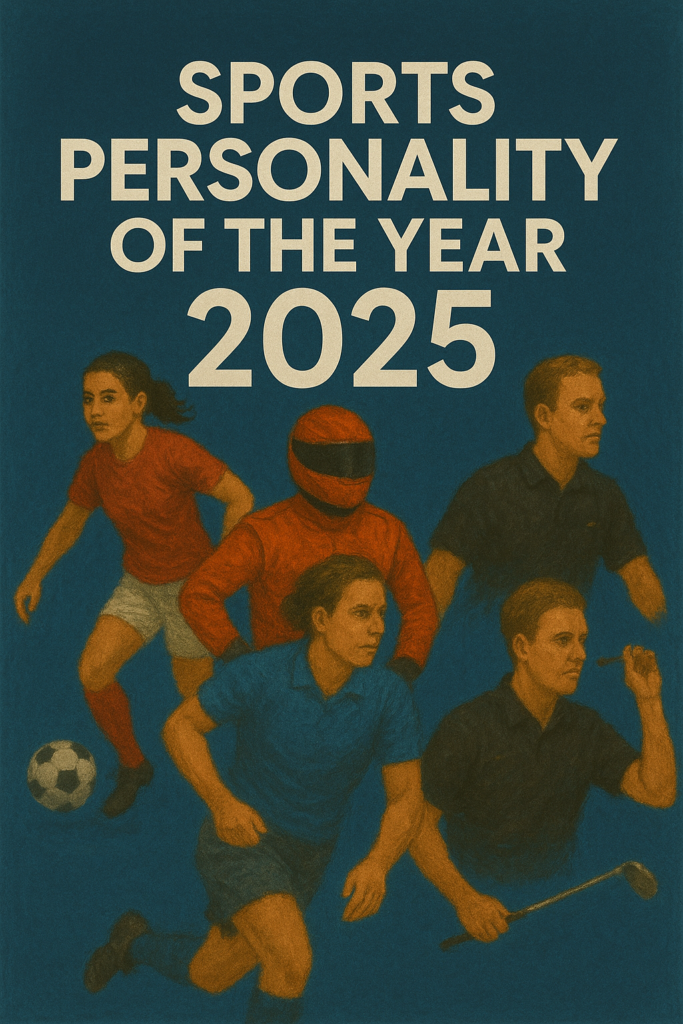
Sports Personality of the Year 2025 Shortlist

spoty shortlist 2025A shortlist of the six contenders for the BBC Sports Personality of the Year 2025 has now been announced. It is as follows:


Chloe Kelly (Football)

Hannah Hampton (Football)

Lando Norris (Formula One)

Rory McIlroy (Golf)

Luke Littler (Darts)

Ellie Kildunne (Rugby Union)


England teammates Chloe Kelly and Hannah Hampton played pivotal roles in winning the Womens Euro 2025 final against Spain so it’s no surprise to see them here. Ellie Kildunne also contributed to what was a fantastic year for womens sport by scoring five tries in Englands 2025 Rugby World Cup campaign, which saw them winning the tournament for the third time.


Elsewhere, Lando Norris as the new Formula One world champion has certainly earned his place too, and Rory Mcllroy made this the year he achieved a grand slam of golf’s four majors, which is a rare achievement in itself. He was runner up at the Sports Personality of the Year awards in 2014 after winning the Open Championship, PGA Championship, and helping Europe win the Ryder Cup that year.


Rounding off this diverse bunch, is 17 year old darts sensation Luke Littler who also featured on the 2024 spoty shortlist finishing runner up (the equal best sports personality placing for any darts player – with Phil Taylor also placing runner up in 2010). Can he go one better this year after winning the World Matchplay, Grand Prix, Grand Slam of Darts and Players Championship Final.


At time of writing here are the winner betting odds for the Sports Personality of the Year Awards 2025:


Rory McIlroy – 1/2

Lando Norris  – 4-1

Chloe Kelly – 9-2

Luke Littler – 18-1

Hannah Hampton  – 33-1

Ellie Kildunne – 50-1


It’s certainly looking good for Rory mcllroy at this stage, in his bid to go one better than his spoty runner up placement from more than a decade ago.

Tommy Simpson 1965

In 1965, cyclist Thomas ‘Tommy’ Simpson was voted BBC Sports Personality of the Year, or Sportsview Personality of the Year, as it was still known at the time. He was the first cyclist to win the award and would be the last until Chris (later Sir Chris) Hoy in 2008. Simpson took the accolade ahead of racing driver Jim Clark, who won his second and final Formula One World Drivers’ Championship that year, and show jumper Marion Coakes, who won a gold medal at the World Show Jumping Championships at Hickstead on her horse, Stroller.

Born in Haswell, County Durham on November 30, 1937, Simpson was one of Britain’s most successful professional cyclists in his tragically short career. Riding for Peugeot–BP–Michelin ,.in September 1965 he became the first Briton to win the Men’s Individual Road Race at the Union Cycliste Internationale (UCI) UCI Road World Championships, staged that year in San Sebastián, Spain. The following month, Simpson became the first and, at the time of writing, only Briton to win the Giro di Lombardia, between Milan and Como, finishing 3’11” ahead of his nearest pursuer, Gerben Karstens of the Netherlands.

Sadly, Simpson died, officially of “heart failure caused by exhaustion” on the thirteenth stage of the 1967 Tour de France, although amphetamines were found on his body and may have contributed to his death. Approaching the summit of Mont Ventoux, a 1,910m peak in the Provence region of southern France, Simpson fell off his bike but, against the advice of his team mechanic, Harry Hall, opted to continue. Shortly afterwards, he fell unconscious and was airlifted to hospital in Avignon, where he was pronounced dead later in the day. He was just 29 years old. A ceremony to mark his death was held the following morning at the start of the fourteenth stage.

Simpson was riding in his sixth Tour de France overall and was lying seventh in the overall race after the twelfth stage. Three years earlier he had become the first and, at the time of his death, only Briton to wear the tellow jersey as the overall leader of ‘La Grande Boucle’, as the race is nicknamed.

Stirling Moss 1961

Few would argue that Stirling Moss, who won 16 Grands Prix in a Formula One career lasting a decade, was the best driver never to win the Formula One World Drivers’ Championship. In fact, he finished second four years running, in 1955, 1956, 1957 and 1958 and third three years running, in 1959, 1960 and 1961. The 1961 Formula One season proved to be his last – he was effectively forced into premature retirement after a crash in the Glover Trophy at Goodwood in 1962 – but Moss did enough to be voted BBC Sports Personality of the Year. In so doing, he finished ahead of boxer Billy Walker, who won the British Amateur Boxing Association (ABA) Heavyweight Championship Final at Wembley in April, and tennis player Angela Mortimer, who won the ladies’ single title at the Wimbledon Championships in July.

The 1961 Formula One season was overshadowed by the death of German driver Wolfgang Von Trips, 33, who was fatally thrown from his car on the second lap of the penultimate race of the season, the Italian Grand Prix at the Monza Autodrome near Milan. The accident also killed 15 spectators, making it one of the most devastating in the history of Formula One. Von Trips posthumously finished runner-up in the World Drivers’ Championship.

In happier times, 1961 was also memorable for two outstanding driving performances from Moss, which allowed him to win two of the eight championship races in his final Formula One season. The first came at the opening race of the season, the Monaco Grand Prix, when, from pole position, Moss took advantage of the superior handling of his Lotus to defeat three far superior, but less nimble, Ferraris on the narrow, twisting track at the Circuit de Monaco in Monte Carlo. It was a similar story in the sixth race of the season, the German Grand Prix at the Nürburgring, in which Ferrari entered four cars; Moss took the lead during the first lap and never surrendered it.

Moss retired from public life in early 2018 because of ongoing health problems and died in April 2020 following a long illness. Sir Jackie Stewart said of him, “…he set a standard that I think has been unmatched since he retired.”

Mary Rand 1964

In 1964, athlete Mary Rand (née Bignal) was voted Sportsview Personality of the Year or, in other words, BBC Sports Personality of the Year, in recogmition of her becoming the first British woman to win an Olympic gold medal in track-and-field. Speedway rider Barry Briggs finished second in the poll of readers of the ‘Radio Times’ after winning the World Championship of Speedway for the third time, while another athlete, Ann Packer, who won the gold medal in the women’s 800m, and silver in the women’s 400m, at Tokyo 1964 finished third. Packer, who roomed with Rand in Tokyo, said of her, “Mary was the most gifted athlete I ever saw. She was as good as athletes get. There has never been anything like her since. And I don’t believe there ever will.”

In the final of the women’s long jump at the Summer Olympics in Tokyo, Rand broke the Olympic record with five of her six jumps and, on her fifth attempt, set a new world record of 6.76 metres on her way to the gold medal. Three days later, she won the silver medal in the women’s pentathlon, which was making its first appearance at the Olympics, and in which Irena Press, of the Soviet Union, set a world record of 5,246 points in winning the gold medal. Another four days later, alongside Daphne Arden, Dorothy Hyman and Janet Simpson, Rand also won a brozne medal in the women’s 4 x 100m relay. In fact, she remains the only woman to have woman three track-and-field medals, of any colour, at the same Olympics.

Rand was created Member of the Order of the British Empire (MBE) in the 1965 New Year Honours and subsequently won the gold medal in the women’s long jump at the 1966 British Empire and Commonwealth Games in Kingston, Jamaica. She retired in 1968, having missed the Summer Olympics in Mexico, but, interestingly, held the unofficial world record in the women’s triple jump until 1981. The International Association of Athletics Federations (IAAF) did not recognise a world record in the event until 1990, but in 1959, as Mary Bignall, she jumped 12.22m in Street, Somerset.